Buyer guide
Modular Home Financing: Can You Get a Conventional Loan?
Yes, many code-built modular homes qualify for conventional financing. Learn how owned land, construction loans, appraisal, and lender requirements work.

Dmitry Bilchenko
Co-founder, Prefably
- Published
- Reading time
- 12 min read

Yes, a conventional mortgage can finance many modular homes. The important distinction is not that part of the house was assembled in a factory. It is whether the finished property is a code-compliant residential improvement that the lender can appraise, insure, and take as mortgage collateral.
The timing changes the loan. If you are buying a completed modular home, the file may look much like an ordinary home purchase. If the factory has not started building, you will usually need construction financing first. If you already own the lot, the lender must underwrite both your land position and the full construction project.
This guide covers local- or state-code modular homes. A HUD-code manufactured home follows different appraisal, labeling, title, and loan rules. If the contract uses “modular,” “manufactured,” and “mobile” as if they mean the same thing, pause and read prefab vs modular before discussing rates.
When a conventional mortgage works for a modular home
Fannie Mae’s factory-built housing guidance treats modular, prefabricated, panelized, and sectional housing through the residential appraisal process. The appraiser must address marketability and comparability, but Fannie Mae does not require every comparable sale to use the same factory-built method.
That does not make every factory package mortgage-ready. The lender still needs an eligible residential property, acceptable plans and permits, a supportable appraised value, clear rights in the land, insurance, and a borrower who meets the selected program. A glossy factory quote proves none of those things.
For a completed purchase, the lender underwrites the borrower and finished property. For a new build, it also underwrites the budget, builder, contracts, plans, site, draw schedule, contingency, and route to completion. This project review is why an eligible modular build can still be delayed by an inexperienced lender.
| Situation | Likely financing path | Main underwriting focus |
|---|---|---|
| Buying a completed modular home | Conventional purchase mortgage | Borrower, appraisal, title, insurance, and completed property |
| Building on land you already own | Construction-to-permanent or construction loan followed by a mortgage | Land equity and liens, plans, contracts, budget, draws, and completion |
| Buying land and building together | Construction-to-permanent loan that includes eligible land and project costs | Acquisition, total cost, appraisal, builder approval, and cash-to-close |
| Buying an unfinished or uninstalled factory unit | Specialized construction financing; not an ordinary completed-home mortgage | Storage, delivery, set, site readiness, remaining cost, and completion risk |
Financing a modular home on land you already own
Owning the lot can simplify the transaction because there is no land purchase to close. It can also create equity that a lender may recognize in the construction structure. Do not assume the tax assessment or what you paid for the lot is the equity figure the lender will use. The appraisal, current liens, seasoning rules, and program determine the usable amount.
Bring the deed, title report, survey, tax information, and details of every lien to the first lender conversation. The lender will also want to know whether access, zoning, utilities, septic or sewer, grading, and the proposed foundation are feasible. Land can have substantial value and still be a poor construction site.
If the land has an existing loan, the construction lender must address lien priority and payoff or subordination. If relatives own the lot, or ownership sits in a trust or business entity, explain that before preapproval. The borrower, landowner, builder contract, and final mortgage collateral need to fit one workable closing structure.
What if the land is leased?
Fee-simple land ownership is the cleanest conventional structure, but “leased land always means chattel” is too broad. Fannie Mae has a specific section for leasehold-estate mortgages. Among other requirements, the leasehold and improvements must constitute real property, the mortgage must reach the leasehold interest, and the lease must be valid and enforceable.
That is a narrow real-estate structure, not permission to place any modular home in any rental community. Lenders may add stricter rules, and many will decline unfamiliar leaseholds. If you do not own the land, send the complete ground lease to a lender and closing attorney before paying a factory deposit.
How construction-to-permanent financing works
A home that does not yet exist as completed real estate usually cannot close with a standard purchase mortgage. A construction-to-permanent loan solves the timing gap: approved costs are released in draws as work reaches verified milestones, then the balance converts to long-term financing after completion conditions are met.
The draw schedule must fit both the factory contract and the site contractor’s schedule. Factories may request deposits or progress payments before a lender is willing to release a draw. Resolve that mismatch in writing before signing. Do not plan to bridge an unapproved factory deposit with emergency cash.
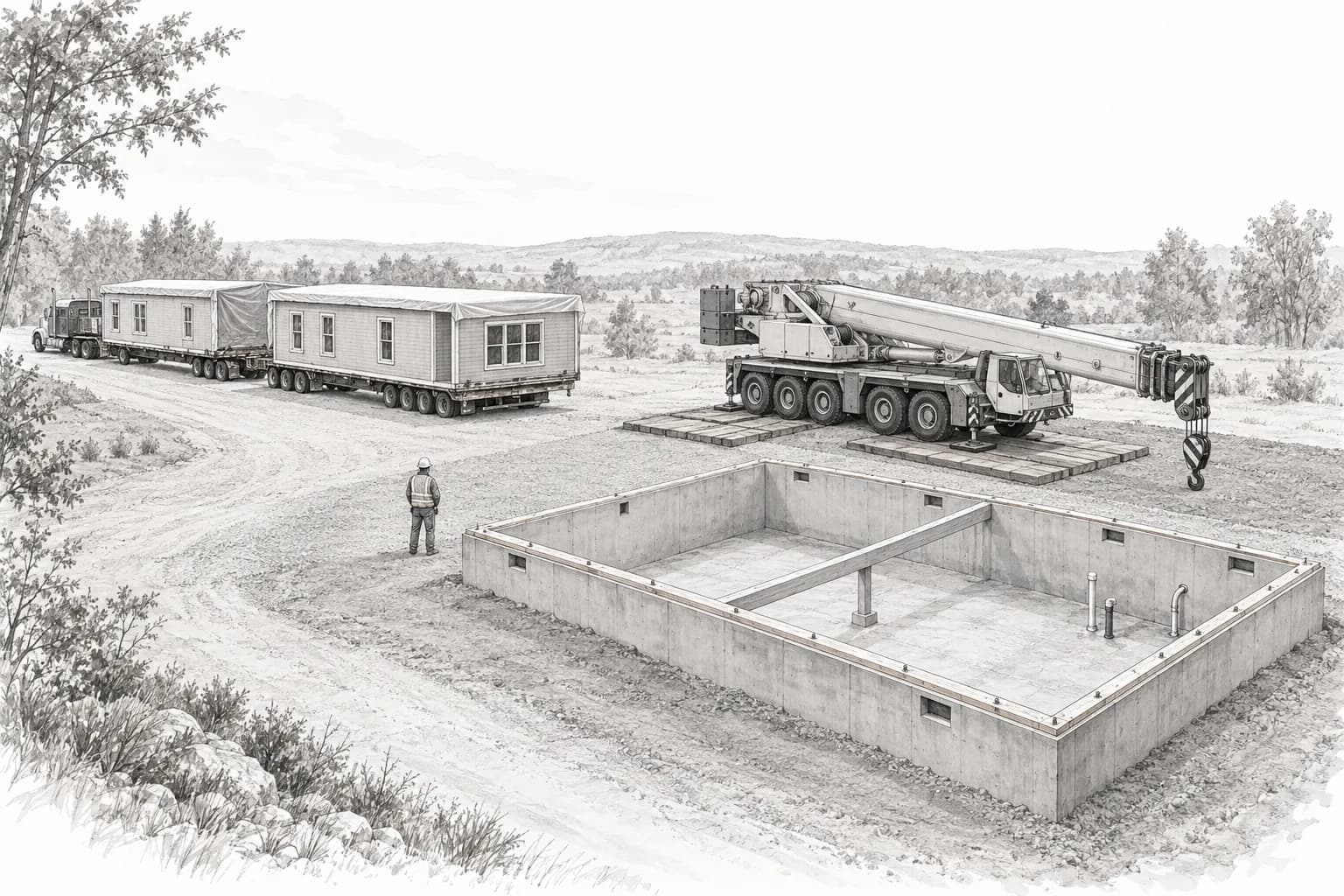
Site work and factory production also need one calendar. If the modules finish before the foundation and access route, storage and redelivery charges may appear. If the site finishes first, rate-lock extensions and carrying costs may grow. The contract should identify who controls scheduling and who pays when either side is late.
Some buyers use a standalone construction loan and refinance after completion instead of a single-close product. That creates a second approval, appraisal, and closing-cost event, and future rates are unknown. Compare the whole structure rather than only the advertised permanent rate.
How appraisers evaluate modular homes
A modular home is not appraised on the manufactured-home Form 1004C merely because it arrived in sections. Fannie Mae appraisal guidance states that on-frame and off-frame modular homes use the standard Uniform Residential Appraisal Report, Form 1004.
The appraiser selects the most appropriate sales for the market. Fannie Mae does not require one or more comparables to be modular, although similar construction can strengthen the analysis when those sales are genuinely comparable. Location, design, quality, condition, utility, site, and market reaction matter more than forcing a weak modular-only comp.
Give the lender and appraiser enough information to understand the finished house: plans, specifications, factory certification or state insignia where applicable, builder contract, site-work scope, foundation design, permits, survey, and projected completion. A vague base-price sheet is not a complete property description.
Documents lenders commonly request
Exact requirements vary, but a modular construction file is easier when the project documents agree with one another. Names, property descriptions, costs, and dates should match across the loan application, deed, contracts, plans, and insurance.
- Deed or purchase contract for the land, title work, survey, and details of existing liens.
- Signed factory and site contracts with a complete schedule of values and clear responsibility for delivery, crane, set, foundation, utilities, permits, and finish work.
- Plans, specifications, engineering, applicable modular certification information, and local permit approvals.
- Site reports required for the project, which may include soil, septic, well, flood, access, grading, or utility documentation.
- Builder and general-contractor credentials, insurance, references, and any lender approval package.
- Construction timeline, draw schedule, contingency budget, deposit terms, and rules for change orders.
- Evidence needed for the completed appraisal, insurance, final inspections, and certificate of occupancy.
Down payment, credit, and reserves
There is no universal “modular-home down payment.” A completed-home conventional mortgage follows the selected program’s borrower and property rules. Some eligible conventional borrowers can use low-down-payment products. Construction loans often require more borrower equity, cash reserves, and contingency because the lender is funding an unfinished project.
The same caution applies to credit scores. A score quoted by one lender may be its overlay, not a universal agency minimum, and pricing can change even when a file remains eligible. Ask for the product name, minimum borrower contribution, reserve requirement, contingency percentage, rate-lock terms, and what happens if the appraisal is below total project cost.
Budget beyond the factory price. Foundation, freight, crane and set, permits, utilities, excavation, driveway access, engineering, insurance, interest during construction, and change orders can all sit outside the base quote. Use the modular home cost guide before deciding how much to borrow.
Modular and manufactured financing are not interchangeable
A true modular home is built under an applicable state or local residential code and inspected through that code path. A manufactured home is built to the federal HUD Code and carries HUD certification labels and a data plate. Manufactured-home programs may involve Form 1004C, vehicle-style certificates of title, title surrender, affidavits of affixture, or chattel financing. Those are not default modular-home requirements.
State terminology can still be messy, and some agencies use “modular” broadly in registration statutes. Rely on the certification and code named in the purchase contract, not the salesperson’s shorthand. Ask the lender to confirm the classification in writing before appraisal.
If you are actually considering a manufactured home, use the broader factory-built home mortgage guide. It covers FHA, VA, USDA, conventional manufactured-home programs, and personal-property lending without mixing those rules into a modular construction file.
Questions to ask a lender before applying
Do not ask only, “Do you finance prefab?” The word is too broad. Describe the project as a state- or local-code modular home and ask questions that reveal whether the loan officer has closed the same structure.
- Have you closed a modular construction loan in this state during the last year?
- Is this a single-close construction-to-permanent product or a construction loan followed by a refinance?
- Can the loan include land acquisition, and how do you calculate equity in land I already own?
- Will you approve the factory and site contractor, and what documents do they need?
- Does your draw schedule match the factory’s deposit and progress-payment schedule?
- How will the modular home be appraised before completion, and which plans and specifications are required?
- What borrower contribution, reserves, contingency, and completion conditions apply?
- Do you finance qualifying leasehold estates, or do your overlays require fee-simple land?
Red flags before you pay a deposit
Pause if the contract does not identify the building code, if a HUD-code manufactured home is being called modular to imply easier financing, or if the lender cannot explain whether it is underwriting a completed purchase or a construction project.
Other warning signs include a large nonrefundable factory deposit before lender and builder approval, missing site costs, a draw schedule that conflicts with the factory contract, pressure to wire money to a personal account, or promises that land equity will cover everything without an appraisal.
The safest order is classification, lender, site feasibility, complete contracts, appraisal and budget review, then deposits aligned with approved draws. That sequence is slower than reserving a factory slot first and much cheaper than discovering an unfinanceable gap later.
Your next steps
Start with two calls: a lender that has recently closed modular construction in your state and a builder that can provide a lender-ready factory and site scope. Give both parties the same land details and ask them to identify missing documents before quoting a timeline.
Search the builder directory for modular companies serving your state and ask for a lender-ready factory and site scope. Prefably does not make loans or decide eligibility. Verify the current program, property, and borrower requirements directly with the lender and appropriate licensed professionals before signing or transferring funds.
FAQ
- Can you get a conventional mortgage on a modular home?
- Often, yes. A completed modular home built to the applicable state or local residential code is generally financed as real estate rather than as a vehicle or chattel. The property, borrower, appraisal, insurance, and lender still have to meet the chosen conventional program’s requirements.
- Can I finance a modular home on land I already own?
- Yes, subject to underwriting. A lender may count eligible land equity toward the project, but the amount and treatment depend on the appraisal, existing liens, loan structure, and lender rules. Ask how the lender calculates land equity before relying on it for cash-to-close.
- Do I have to own the land to get a conventional modular-home mortgage?
- Fee-simple ownership is the simplest path, but it is not the only possible one. Fannie Mae permits qualifying leasehold-estate mortgages when the leasehold and improvements are real property, the lease is enforceable, and the mortgage can attach to the leasehold interest. Many lenders apply stricter overlays, so leased-land eligibility must be confirmed before ordering the home.
- Does a modular home need a vehicle-style title conversion?
- Usually not in the way a HUD-code manufactured home does. A true modular home is built to the applicable residential building code and becomes part of the real estate when installed through the local building process. State procedures vary, so the closing agent should still confirm how the completed improvement will appear in local land records.
- How is a modular home appraised for a conventional loan?
- Fannie Mae guidance uses the standard Uniform Residential Appraisal Report, Form 1004, for modular homes rather than the manufactured-home Form 1004C. The appraiser should use the most appropriate comparable sales; the comparables do not all have to be modular homes.
- Do I need a construction-to-permanent loan for a modular home?
- Usually when the home has not been built or installed yet. A construction-to-permanent loan can fund approved factory work, site work, delivery, set, and completion before converting to long-term financing. A completed modular home being purchased from its current owner may qualify for an ordinary purchase mortgage instead.
- Is a modular home financed the same way as a manufactured home?
- Not necessarily. Modular homes are built to an applicable state or local residential code. Manufactured homes are built to the federal HUD Code and have separate labeling, appraisal, title, and program rules. Confirm the code classification in the contract before comparing loan quotes.
- What down payment and credit score does a modular-home loan require?
- There is no single modular-home minimum. Requirements depend on the conventional product, occupancy, borrower profile, project risk, and lender overlays. Some conventional programs allow low down payments for eligible borrowers, while construction financing may require more equity, reserves, and contingency funds.
Keep reading