Buyer guide
Factory Home Budget: What to Expect Beyond the Base Price
What a factory sticker actually covers in 2026, the site and setup line items that sit on top, two landed-cost worksheets, and how financing and lot rent change the long-term budget.

Dmitry Bilchenko
Co-founder, Prefably
- Published
- Reading time
- 8 min read
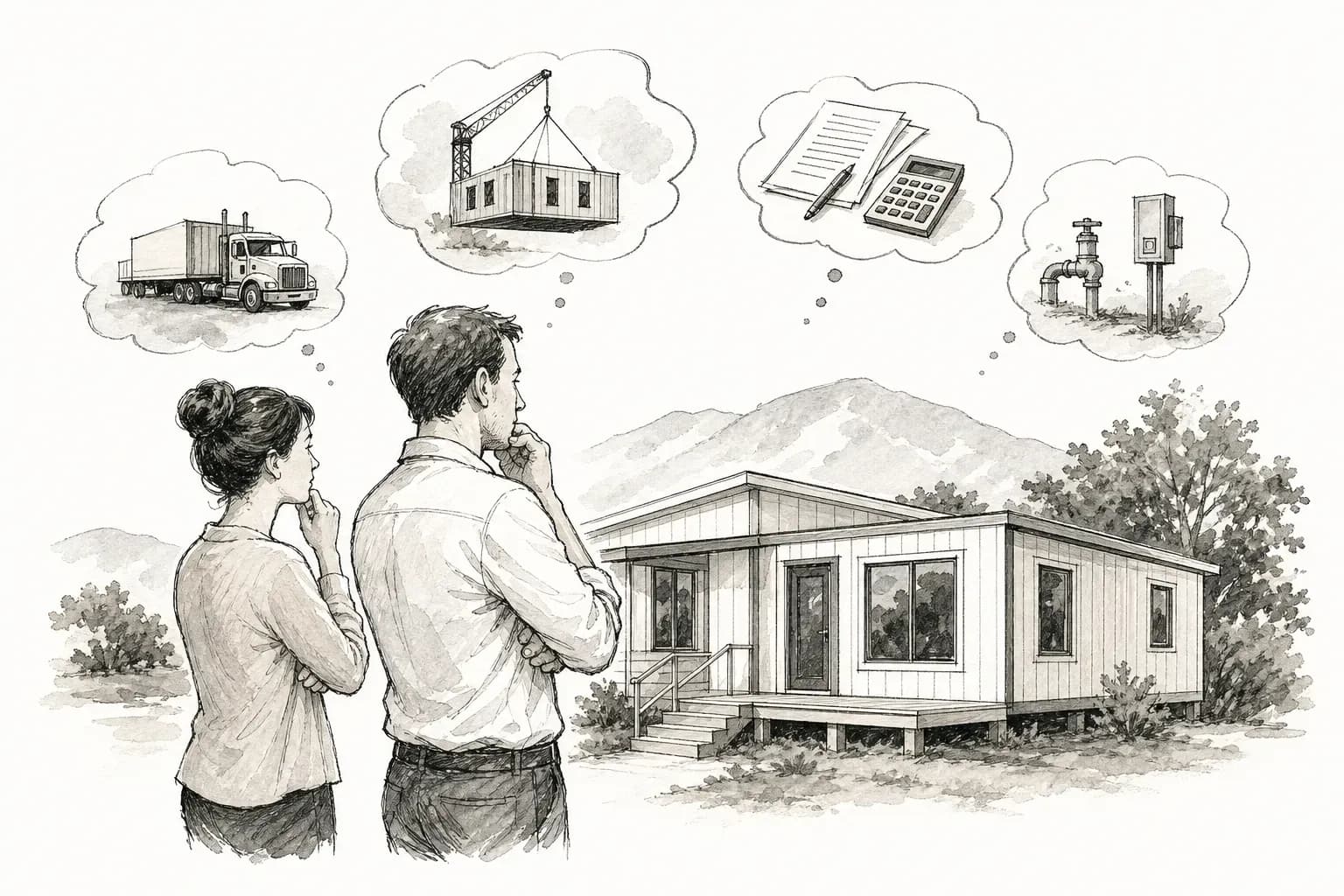
A double-section listed around $164,000 looks like a number you can plan around. That figure is the factory price: the home as it leaves the plant. It does not include land, a foundation, the truck, the set crew, county permits, or the hookups that make the building livable. Occupancy costs more than the sticker.
Buyers who skip those lines often find the landed cost 20 to 50 percent above the factory quote, and more on raw land. This guide is a budget worksheet for HUD-code manufactured homes first, with a pointer to modular where the code path changes the loan. Prefably is a directory, not a dealer. Browse companies by state and contact them directly. Prefably does not sell the inquiry as a lead.
What the factory price actually covers
Census stickers in 2026
The Census Bureau’s Manufactured Housing Survey, via FRED put the average new manufactured home at $137,500 in March 2026: about $90,700 for a single-section and $164,200 for a double. That is the home only. Not land, not tax, not installation.
Treat that number as line one. Do not lock a loan or a lot around it until the rest of the sheet is filled. For the labels, prefab vs modular is the short split: HUD-code manufactured is a federal data plate; modular is state or local code.
How modular quotes differ
Modular is a different sticker. Prefably’s working bands are about $50 to $100 per square foot for the factory box and $80 to $160 all-in in most markets. The modular cost guide is the longer version. Regional 2025 installed ranges are in modular home price per square foot by state. Do not average a manufactured Census price against a modular turnkey bid and call it research.
Region still moves both products. The South is often cheaper to set. The Northeast and West Coast add labor, foundation, and permit cost. Use that as a direction, not a transplanted total.
Setup costs most factory quotes leave off
Site prep, delivery, and foundation
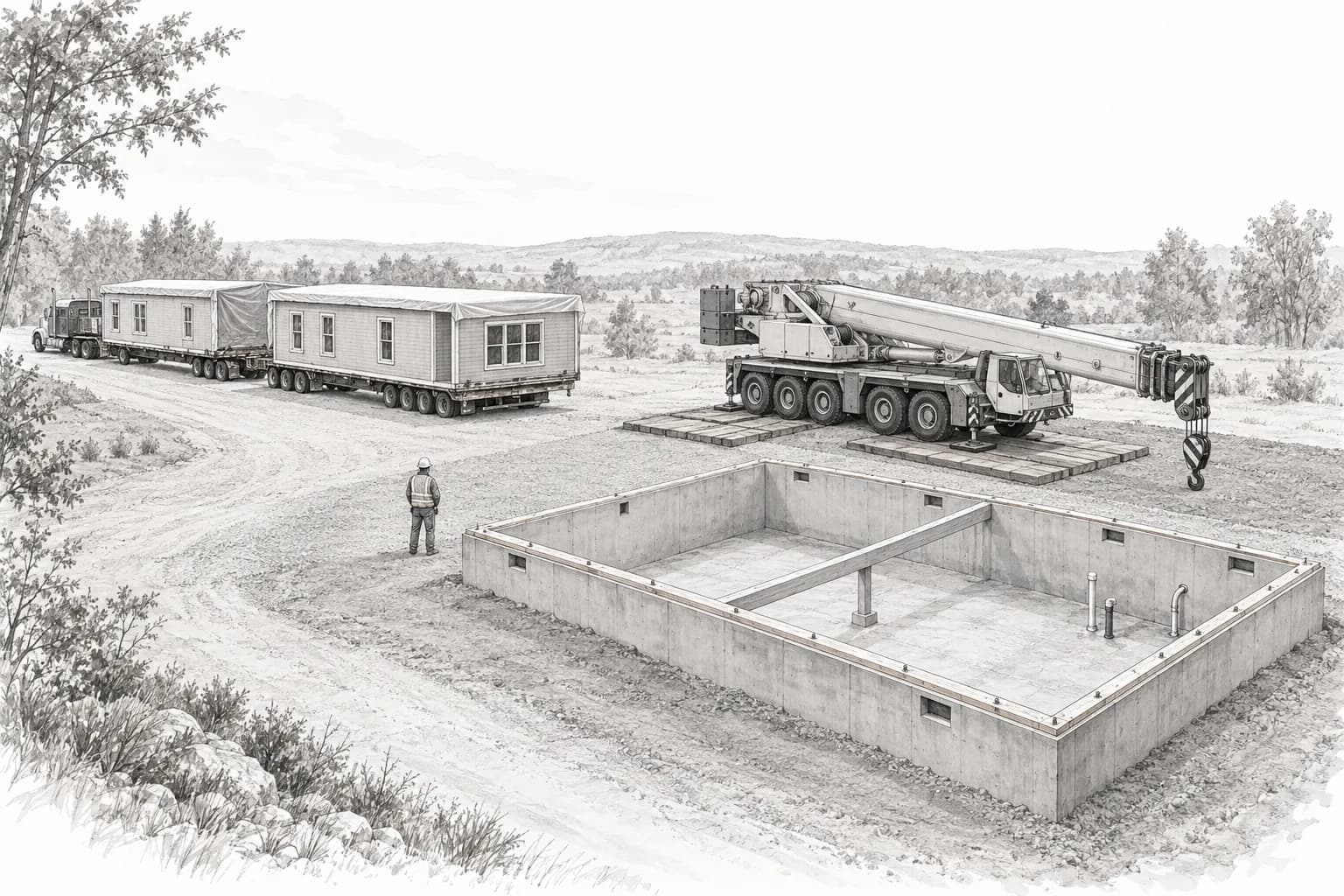
The lot has to take a truck and a box. Site preparation commonly runs $2,000 to $15,000 for grading, clearing, and access. Delivery is often $3,000 to $10,000, more on a long haul or a tight rural road.
Foundation is the swing item. A basic pier-and-blocking system might be $3,000 to $6,000. A full concrete slab can be $5,000 to $25,000 or more. Loan path depends on this choice. FHA Title II and VA products usually want a permanent foundation and real-property title. A cheap pier that keeps the home in chattel can cost more in interest than it saves in concrete. Make that call before you order the house.
Utilities, permits, skirting, and the set
Water, sewer, electric, and gas run $2,500 to $30,000 or more. Existing taps at the lot line sit at the low end. A well and septic on raw acreage sit at the high end. Get those contractor numbers before you buy the land.
Permits and inspections typically run $500 to $5,000. Skirting is easy to forget and still real: $500 to $8,000. Set work, leveling, tie-downs, and a crane for multi-section homes add $3,000 to $15,000. Skipping permits is not a savings. Unpermitted work hits insurance, resale, and refinance.
| Line (ranges, not a bid) | Typical 2026 band |
|---|---|
| Factory price (Census, Mar 2026, home only) | Single ~$90,700; double ~$164,200; avg ~$137,500 |
| Site prep (grade, clear, access) | $2,000–$15,000 |
| Delivery / transport | $3,000–$10,000 |
| Foundation (pier vs permanent slab) | $3,000–$25,000+ |
| Utilities (or well and septic on raw land) | $2,500–$30,000+ |
| Permits and inspections | $500–$5,000 |
| Skirting | $500–$8,000 |
| Set crew, leveling, crane | $3,000–$15,000 |
Two landed-cost worksheets
These are stacked examples, not quotes. Every county and every lot will move a line.
Suburban single-section, utilities at the lot line. Factory $90,700. Site prep $3,500. Delivery $4,000. Pier foundation $5,000. Hookups $3,000. Permits $1,200. Skirting $1,500. Set $4,000. Landed cost about $112,900, roughly $22,000 over the sticker.
Rural double-section on raw land. Factory $164,200. Clearing and grade $12,000. Longer delivery $9,000. Permanent slab $18,000. Well and septic $22,000. Electric and propane $6,500. Permits and impact fees $3,800. Skirting and set $10,000. Landed cost about $245,500, roughly $81,000 over the sticker. That is why the factory number is not the house.
How to pressure-test the factory line
The factory price is the line you can actually shop. One dealer quote is not a market. Two or three written prices from companies that deliver to your county is a market.
Prefably lists manufactured, modular, and prefab companies by state. Open profiles, check delivery notes, and email the firms yourself. Ask for a factory-versus-site split in writing. Reluctance to itemize is a signal. Browse builders by state and keep the inquiry off a lead board.
Financing changes the same sticker
VA and USDA can be zero-down when the home is permanently affixed on land you own and treated as real property. FHA Title II is often 3.5 percent down on the same setup. Conventional products are in a similar down-payment band when the file qualifies. Chattel loans cover personal-property title or a land-lease community. Down payments and rates vary by lender. Chattel quotes often ask for more cash up front than a real-property mortgage and price higher, with shorter terms. CFPB research on manufactured-home lending found chattel APRs well above prime mortgage offers. Treat that gap as directional, not a surveyed 2026 median.
On a $150,000 loan, principal and interest only, a 30-year note near 7 percent is about $998 a month. Twenty years is about $1,163. Fifteen years is about $1,348. The same $150,000 as chattel at 10 percent over 20 years is about $1,448. Taxes and insurance are extra. Foundation and title decide which column you are in. The factory-built home mortgage guide names the programs. Prefably does not broker loans.
Costs that continue after move-in
Lot rent in a community often runs $200 to $1,000+ a month nationally, or $2,400 to $12,000+ a year. Utilities commonly sit around $2,000 to $4,000 a year. Manufactured-home insurance is often $300 to $1,500 a year, more on the coast or in high-risk maps.
A maintenance reserve of 1 to 2 percent of the home’s value per year is a planning rule, not a quote. On a $160,000 home that is $1,600 to $3,200. In a land-lease park with modest utilities, ongoing ownership can total $8,000 to $20,000 a year.
Own the land and lot rent drops out; property tax replaces it. That is usually cheaper per year than park rent, with more cash due at purchase. The land model also decides which loan you can use.
Put the sheet together before you talk to a dealer
Start with the factory line, then site prep, foundation, delivery, set, hookups, permits, and skirting. Adjust for the lot you actually have. Then collect two or three factory quotes from companies that serve your state so line one is a 2026 number, not a screenshot.
Build the worksheet first. Browse builders by state second. Read modular home financing if the product might be modular instead of HUD-code. That order beats walking into a sales office with only a sticker.
Sources
Prefably does not provide construction, legal, appraisal, insurance, or lending advice. Requirements and costs vary by jurisdiction, property, contractor, and financing program. Verify the project with the relevant building officials and qualified professionals before signing contracts or transferring funds.
- FRED: Average Sales Price of New Manufactured Homes, Total Homes in the United States (SPTNSAUS)
- FRED: Average Sales Price of New Manufactured Homes, Single Homes in the United States (SPSNSAUS)
- FRED: Average Sales Price of New Manufactured Homes, Double Homes in the United States (SPDNSAUS)
- U.S. Census Bureau: Manufactured Housing Survey
- U.S. Department of Housing and Urban Development: Manufactured Housing Programs
- CFPB: Manufactured Housing Finance, New Insights from HMDA Data (2021)
FAQ
- What is typically included in a factory home budget?
- The factory price of the home, plus site preparation, foundation, delivery, set crew, utility hookups, permits, and skirting. On raw land, a well and septic can add tens of thousands on their own. Land purchase or lot rent is a separate line.
- How much more than the factory price will I actually spend?
- Setup often adds 20 to 50 percent on top of the factory sticker, and more on raw acreage. A single-section home on a utility-ready suburban lot might add about $20,000 to $25,000. A double-section on raw rural land can add $75,000 to $90,000 or more. Those are worksheets, not bids.
- What is the difference between a chattel loan and a mortgage for a manufactured home?
- A chattel loan treats the home as personal property and usually carries a higher rate and a shorter term. A real-property mortgage needs the home permanently affixed on land you own. The rate gap compounds. Details are in the factory-built home mortgage guide.
- How do I get factory price quotes without a lead marketplace?
- Prefably is an independent directory. Browse manufactured and modular companies by state, open profiles, and contact them yourself. Your inquiry is not resold as a lead. Ask each firm for a written factory-versus-site split before you compare numbers.
Keep reading