Research
Prefab Homes From China vs US Modular
Prefably’s comparison of Alibaba-style Chinese prefab listings and US modular plants: a 2025 capsule quote, duties, scams, how sourcing actually works, and why the factory sticker is not the house.

Dmitry Bilchenko
Co-founder, Prefably
- Published
- Reading time
- 15 min read
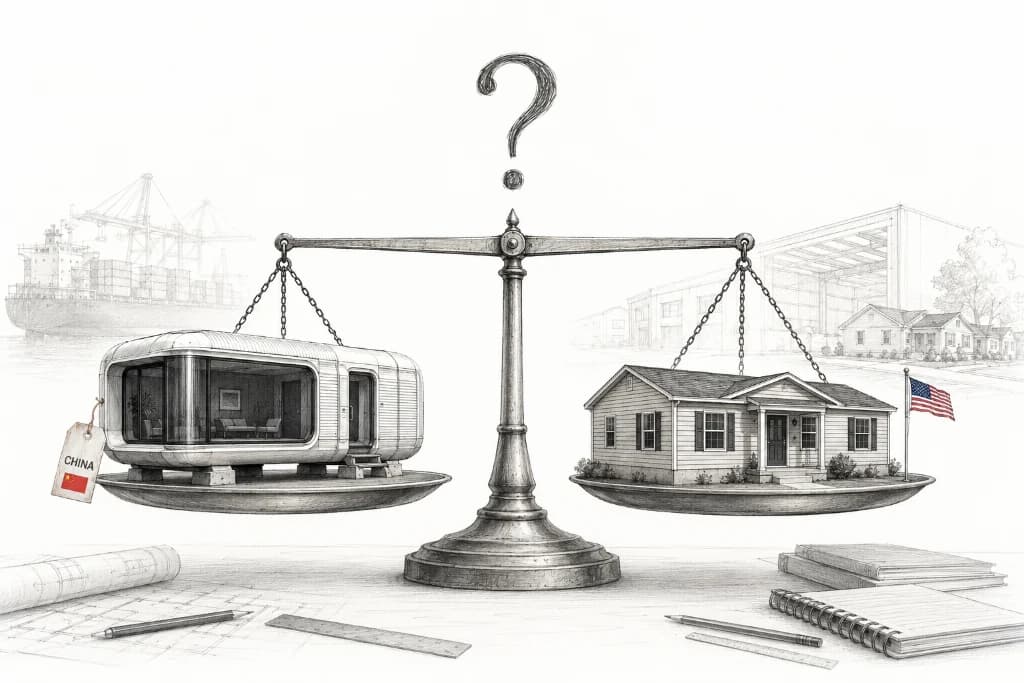
Prefably is a US directory of prefab and modular builders. Most weeks the team is on the phone or in email with American plants: who actually ships to which county, what they will put on a data plate, what a dealer lot costs versus a custom modular set. In parallel, buyers keep forwarding marketplace links. A folding 40-foot box for five or six thousand dollars. A capsule bathroom pod. A light-steel villa render that looks like a $400,000 house. Prefably has also sourced and visited Chinese manufacturers, including sitting with a 2025 quote on an 11.5-meter space capsule. This is not a treatise on import law.
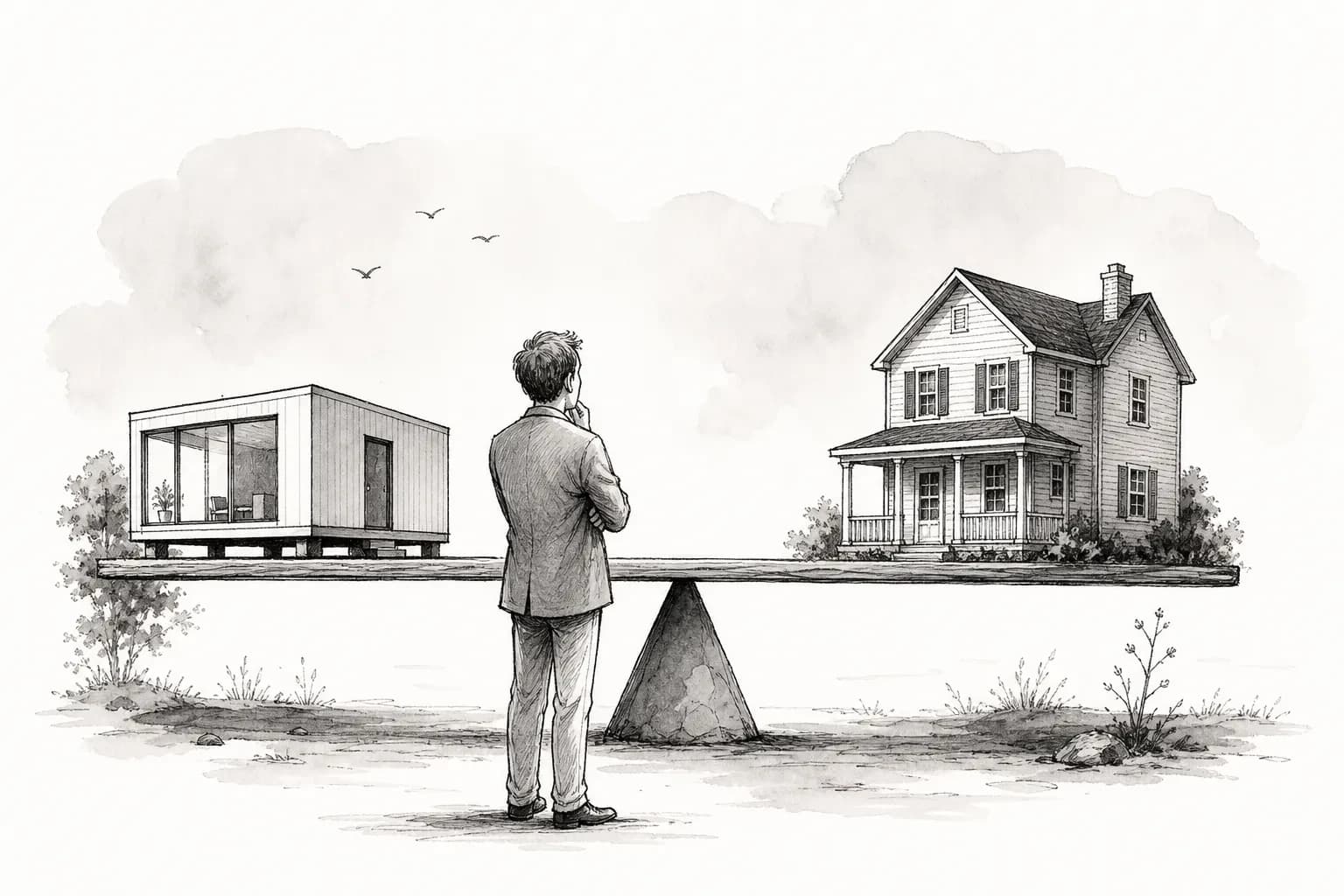
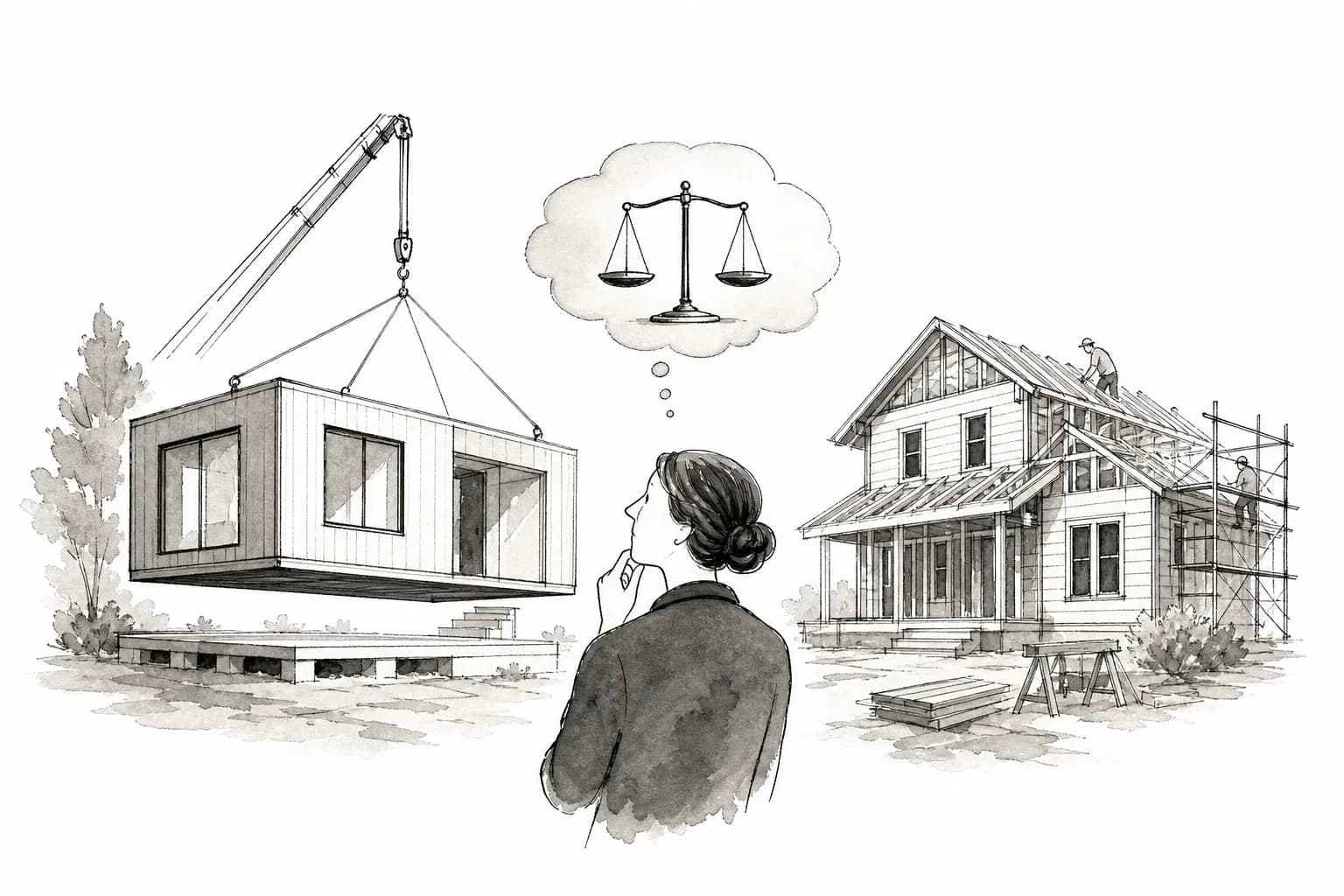
The comparison is ugly in a useful way. The Chinese sticker usually wins. The US plant usually wins the part where you occupy the building, finance it, and have someone to call when a window leaks.
What shows up on Alibaba
The listings cluster into three piles. Expandable containers that fold out from a 20-foot or 40-foot envelope. Capsule or “space” pods with a bathroom core. Light-steel villas and kit frames that look more like a house in the CAD. None of those are automatically a US modular home. In the US that word means sections built to state or local code, inspected in the plant, and labeled before they roll. Prefably’s prefab vs modular guide is the longer version of that split.
Prices move with insulation, bathrooms, and whether the order is one unit or twenty. Export listings Prefably checked in 2025 quoted 40-foot expandables around $5,999 each for small quantities, $5,666 in the teens, and $4,999 in volume, with a $20,000 “sample” price on the same page. Other exporter writeups put a more finished 40-foot expandable in the $12,000 to $22,000 FOB band. Treat those as catalogs, not bids. Ask for the steel thickness, the insulation spec, 110/120-volt drawings, and a video of *your* unit on the line before anyone gets a deposit.
There is a second Chinese industry that does not live on those $5,999 tiles. Some plants sell light-gauge steel systems to developers and talk ICC-ES and country-specific engineering. That is closer to a real building system. It is also not the short-form video house. If a US company is quietly buying from China, it is more often this channel, or a trading company sitting in front of a factory, than a one-click capsule.
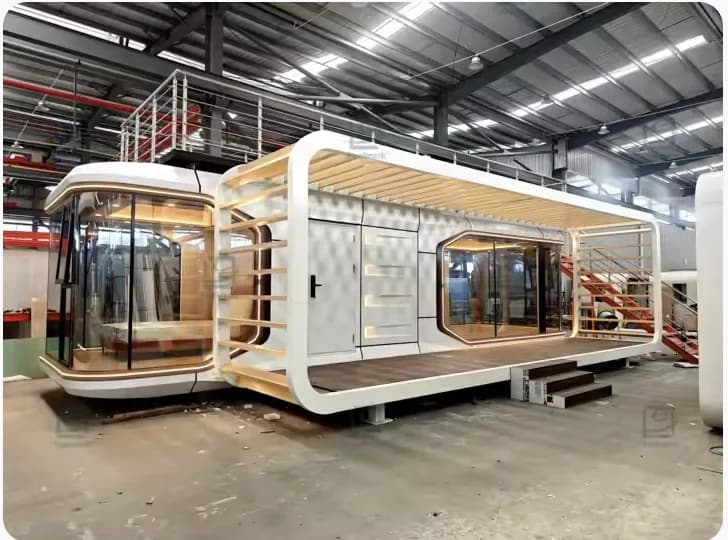
One capsule Prefably priced in 2025
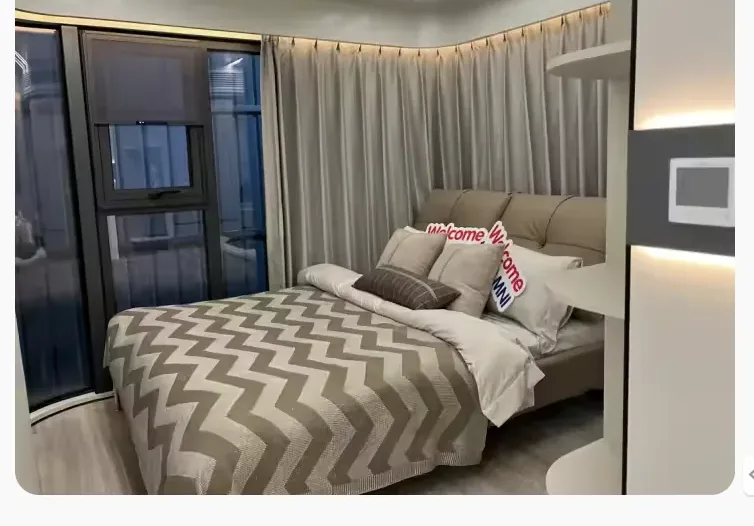
In September 2025 Prefably asked a Guangdong plant for a written quote on an assembled 11.5 × 3.3 m capsule, 38 square meters, loaded in a 40-foot flat-rack. The shell was $18,571 EXW. Full options (air conditioner, kitchen, Murphy bed, stair, second-floor balcony, projector) added $8,930. House plus options: $27,501. The quote is explicit: taxes and shipping are not included. Freight is collect.
Days earlier, a different marketplace seller sent a chat estimate on the same size class: an 11.5-meter capsule, one bedroom, one bathroom, one living room, about $21,000 to $22,000, plus $9,000 to $10,000 shipping to a US port, $30,000 to $32,000 total to the pier. That message was an approximation before details. The written sheet is the tighter number. Neither figure is a US house.
Add what both quotes left off. If the entry still sits under HTS 9406 and Section 301 still adds about 25% on Chinese-origin goods in that heading, duties on a $27,501 declared capsule are often in the $7,000 to $8,000 band (MFN plus 301). Ocean freight in the $9,000 to $10,000 chat range puts you around $45,000 toward the US port, still before inland trucking, a crane, a pad, a US electrician, and a building official. Prefably is not the broker on this SKU. Those duty dollars are a worksheet, not an entry summary.
| Line (Prefably 2025 capsule file) | Amount |
|---|---|
| 11.5 × 3.3 m shell, EXW, 40FR load | $18,571 |
| Full options (AC, kitchen, Murphy bed, balcony, stair) | $8,930 |
| House + options, still EXW, tax and freight extra | $27,501 |
| Ocean freight to a US port (separate Alibaba estimate) | $9,000–$10,000 |
| US duties / tax | Not in the quote |
| Crane, pad, electrician, permits, occupancy | Not in the quote |
There is no Alibaba of American housing
In the US there is no single floor where you browse every modular plant, compare quotes, and message ten factories before lunch. You search, you call a dealer, you land on a plant website that may not even list a price. Prefably is a directory of those companies. It is not a bidding market. China is the opposite. The exporters sit on Alibaba. That concentration is the advantage, and also why buyers get burned: the same place that has real plants has trading companies wearing a factory costume.
Knowing that platform is a skill. How to read a Gold Supplier badge without treating it as a UL listing. How to send the same spec to five sellers so you can see who is guessing. How to negotiate without looking like someone who will pay the first number. Chinese suppliers can become excellent long-term partners. The ones who last are usually the ones treated as a factory relationship, not a cart checkout. That takes practice and research.
American business culture likes a short email, a PDF, a signature, a Friday ship date. A lot of Chinese export sales still run on WeChat, relationship, and a no that never quite says no. Face matters. A public accusation in the message thread can kill a deal that a private correction would have saved. Language is the other tax. The listing English is often better than the engineering English. Specs drift in translation: steel thickness, fire rating, a “UL” that is actually a lookalike mark. A bilingual drawing set and a US electrician on the call still belong in the process.
Alibaba has also added tools that change how search works. AI Mode is useful as a search and inquiry layer: describe the unit instead of guessing keywords, and it can start conversations with more context than typing “container house” into the old box. Separate from that, Alibaba International has an agent platform called Accio (Accio Work). Plug it into the marketplace, prompt what you need, and it can spin up specialized agents that find suppliers, message several at once, chase answers across time zones, and negotiate inside the limits you set. Alibaba says the agent still cannot close the purchase order or send payment without you. Treat it as a fast intern who does not know the destination county inspector. Do not let it wire a deposit.
What a US plant is actually selling
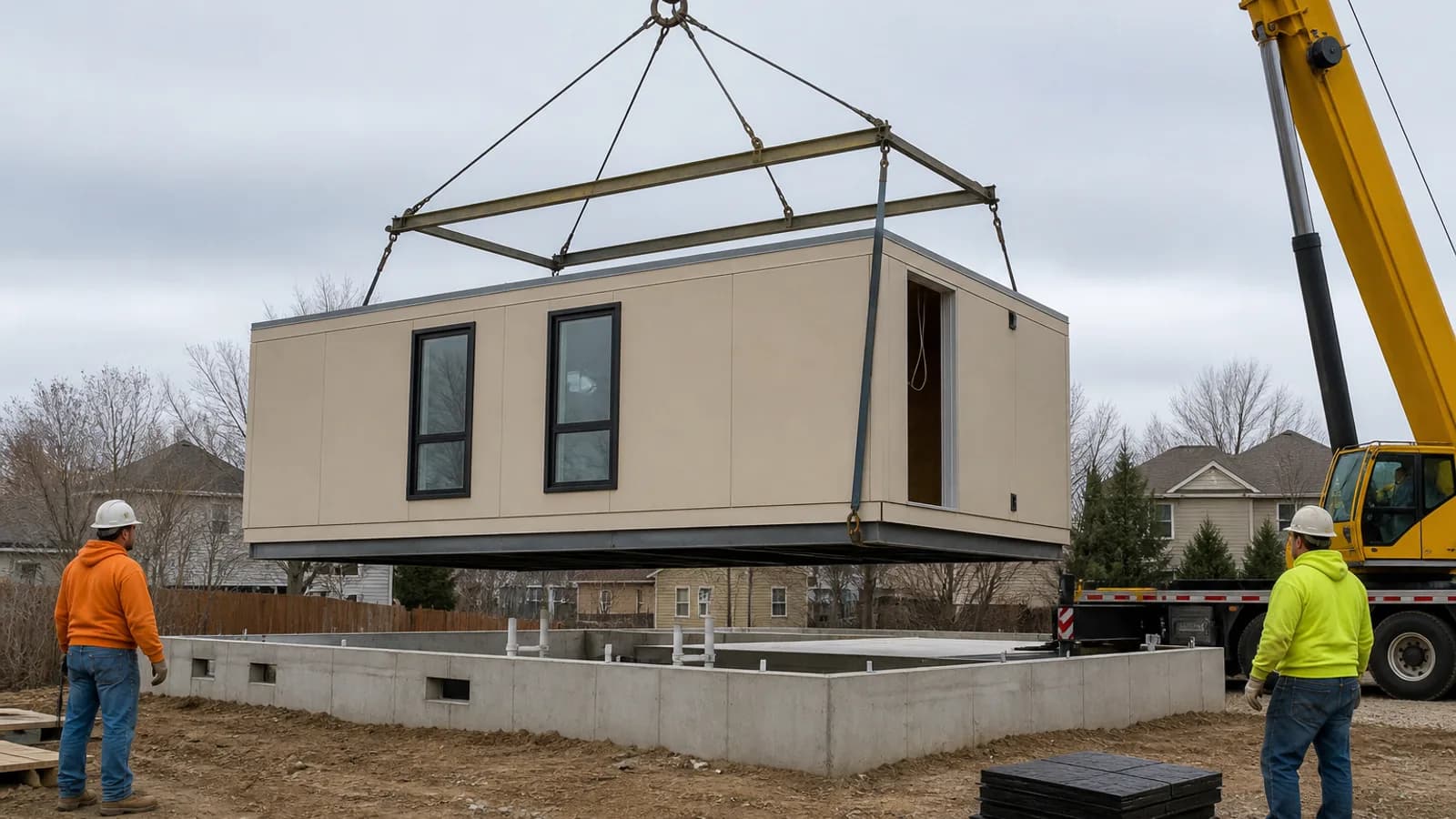
When Prefably talks to companies in the directory, the product that closes is usually the boring one. A modular plant builds to the same residential code as the house next door, then trucks sections that are mostly finished. A manufactured-home plant builds to the HUD Code. Different label, different loan. Same idea: a third-party inspector was in that factory, and a US company will still exist if there is a problem.
Census numbers are not exciting, which is the point. The Manufactured Housing Survey (via FRED) put the average new manufactured home at $137,500 in March 2026: about $90,700 single-section and $164,200 double. That is the home, not the land. For state-code modular, the ranges Prefably uses are about $50 to $100 per square foot for the factory box and $80 to $160 all-in in most markets. The modular cost guide walks through why the lot can blow that up.
| Chinese export listing (typical Alibaba) | US modular / manufactured | |
|---|---|---|
| Sticker | Often $5k–$22k FOB for expandable cabins; villas higher | Census ~$137k avg new manufactured (Mar 2026); modular factory often $50–$100/sq ft |
| What the number includes | The box, sometimes a bathroom package. Rarely your county’s code. | A labeled home. Site work is still extra. |
| Mortgage | Usually cash. Occupancy is a local official’s call. | Construction-to-perm, FHA, VA, USDA when the setup qualifies |
| If it goes wrong | WeChat, a PRC warranty, a trading company that may not own the plant | A US company, insurance, a plant you can visit |
Documented imports, including the ones that went wrong
There is no statistically clean sample. There are public threads, a few itemized cost stacks, and electricians who opened the walls. Buyer threads are mixed: some people got a box, some got a different spec than they ordered, a lot never completed a purchase. US electricians talking about imported Chinese ADUs are blunter. The wiring is often 220 volt / 50 hertz logic in a 120/240, 60 hertz country, and it is frequently not NEC practice.
One public 2025 project is useful because it is itemized. A US importer put two Chinese prefab houses on a lot as rentals. Published numbers landed at $118,780 all-in. The factories were $15,600 each. Then freight, taxes, septic, a move, grass, a $7,000 scam, and other costs she published without a matching line item. That is about $59,000 per cabin, and it is still two imported boxes, not two HUD-labeled homes. The scam line is the one to stare at. Everything else can go right and the wire can still land on the wrong WeChat account.
| Her line items (two houses) | Amount |
|---|---|
| Factory ($15,600 × 2) | $31,200 |
| International transport | $10,200 |
| Taxes / duties as reported | $9,900 |
| Move to the site | $1,100 |
| Septic | $10,000 |
| Grass | $2,000 |
| Scam | $7,000 |
| Other published costs (not itemized in the cited clips) | $47,380 |
| Total she published | $118,780 |
Taxes, duties, and the quote that forgot them
The number that matters is landed cost, not the FOB sticker. Most marketplace prefab tiles are FOB: the box at the Chinese port. A DDP quote would mean delivered and duty-paid toward the US site. Treat a DDP claim as something a broker still has to verify. Prefab buildings usually sit under HTS 9406 at the USITC. Wood is 2.6% MFN (9406.10). Steel modular units are 2.9% (9406.20). Chinese-origin goods have often also owed Section 301 additional duties around 25% on this heading. Exporter blogs still say “duties 0%.” That is how a spreadsheet blows up. Rates move. Prefably is not a customs broker. Pay one to classify the exact SKU before celebrating a $5,999 FOB.
Freight is the other line people skip. A 40-foot box China to the West Coast has been a few thousand dollars in quiet months and worse when the market spikes. East Coast costs more. Then terminal fees, a broker, inland trucking of something that may need a flatbed and a crane, and demurrage if you are not at the port. Marine insurance is cheap compared to a crushed expandable.
How the scams usually work
The pattern is not mysterious. A trading company poses as the factory. The Alibaba storefront is real enough. The workshop in the video is someone else’s. You pay 30 to 50 percent by T/T to a personal account “because the company account is delayed.” The unit that ships is a thinner steel, no insulation, 220-volt panels, missing glass. Trade Assurance helps if you stayed inside Alibaba’s rails. It does not help if you hopped to WhatsApp and Western Union.
The same checklist applies when vetting a plant. Video call from inside the shop, not a hotel lobby. Business license that matches the bank account name. A deposit in escrow or Trade Assurance, never the full amount. A packing list and photos of *your* serials before stuffing. A US electrician looking at the panel drawings before the container leaves. If they will not do those things, they are not the supplier.
- Confirm the legal entity on the invoice matches the factory you toured, on video or in person.
- Keep payment on the platform or in escrow. Personal-account T/T is how the $7,000 line happens.
- Get 120/240 V, 60 Hz, listed devices in the contract, not “we change it on site.”
- Name the destination county and wind/snow values on the drawings, or you are importing a science project.
Why some companies still order
US operators do buy, and some keep buying: glamping, workforce housing, a backyard rental in a county that shrugged, a developer who wanted a steel kit and hired a US engineer to restamp it. Alibaba reviews on those storefronts are not worthless. They are also not a substitute for walking the line. Screenshots of “Gold Supplier, 200 orders, US buyers” are more useful when they show repeat orders from the same company name, not five-star blurbs.
If you still want to try it
For a primary residence that needs a mortgage, start with a US modular or HUD-code plant first. That is the product Prefably exists to help people find, and Prefably still does not sell the inquiry as a lead.
For a cash cabin, an ADU experiment, or a small hospitality cluster, China can make sense if it is treated as manufacturing, not shopping. Importer of record. A third-party inspector the destination state already knows, in the plant during production. Electrical designed for the US before stuffing. One pilot, then a SKU. Do not sit on a yard of unlabeled boxes and hope Facebook Marketplace is a housing company.
If you want help finding a factory
Prefably is a US directory. The team also works both sides of this comparison: talking with local American builders every week, and sourcing and visiting manufacturers in China. If the goal is to order from China, or to tell a real plant from a trading company, write. Include the state, the use (house, ADU, rental, glamping), and a budget that includes freight and duties, not just FOB.
Use the contact form (pick China sourcing) or email hello@prefably.com. LinkedIn is fine too: Dmitry Bilchenko. Prefably is not a licensed customs broker and will not take a wire to “handle the import” as a black box. The team will look at the factory with you and say what not to sign.
Sources
Prefably does not provide construction, legal, appraisal, insurance, lending, or customs advice. Requirements, costs, tariff classification, and duty rates vary by jurisdiction, property, contractor, financing program, and SKU. Prefably is not a licensed customs broker. Verify the project with the relevant building officials, a licensed customs broker, and other qualified professionals before signing contracts or transferring funds. Confirm HTS classification and Section 301 treatment for the exact SKU before relying on any duty worksheet.
- U.S. International Trade Commission: Harmonized Tariff Schedule search, heading 9406
- USTR: Section 301 China tariff actions and HTS product search
- FRED: Average Sales Price of New Manufactured Homes, Total Homes in the United States (SPTNSAUS)
- CiberCuba: published cost stack for the two imported Chinese houses
FAQ
- How much does it cost to order a prefab home from China?
- It depends on the product. Expandable cabins often list around $5,000 to $22,000 FOB. In September 2025 Prefably priced an 11.5 × 3.3 m space capsule at $18,571 for the shell and $27,501 with full options, EXW, taxes and shipping extra. A separate marketplace chat on the same size class quoted about $9,000 to $10,000 ocean freight to a US port. Duties, a pad, a crane, and an electrician sit on top of that. One public 2025 US import of two cheaper boxes landed around $59,000 each all-in after freight, taxes, septic, and a $7,000 scam.
- Can I import a modular home from China?
- You can import a prefabricated building. That does not make it a US modular home. Modular in the US means state or local code, in-plant inspection, and a state insignia. An Alibaba cabin is typically cash, and occupancy is a local official’s call. Lenders usually want HUD-code manufactured or US-labeled modular.
- Are Chinese prefab homes good?
- Some export plants build serious light-gauge steel systems for developers. Many Alibaba tiles are expandable cabins and capsules with catalog photos. Quality tracks the spec you lock in writing, whether the workshop matches the invoice, and whether the electrical is 120/240 V, 60 Hz. Gold Supplier badges are not a substitute for that.
- Are the Alibaba prices real?
- The FOB numbers are often real enough as a factory starting point. 40-foot expandable listings commonly sit around $5,000 to $6,000 per unit, cheaper in volume, with nicer fit-outs quoted much higher. That price is not a US house. Freight, duties, a pad, electrical, and a county inspector sit on top, and some buyers still lose a deposit to a trading company that was never the plant.
- Can I mortgage a Chinese prefab in the US?
- Usually not as shipped. Lenders want a HUD-code manufactured home or a modular home with a state insignia. An imported cabin is typically cash or a construction loan, and only if the building official will treat it as a dwelling.
- Can Accio or Alibaba AI Mode replace talking to the factory?
- They can shortlist listings, send inquiries, and chase quotes across time zones. They cannot tell you whether the workshop in the video is the legal entity on the invoice, and they do not know the destination county inspector. Use them to reach a shortlist, then get on a video call inside the plant.
- Can Prefably help me find a factory in China?
- Yes. Email hello@prefably.com or use the contact form with the China sourcing topic. Prefably talks with US plants every week and has sourced and visited Chinese manufacturers. Prefably is not a customs broker. The team will tell you what to check before anyone wires money.
Keep reading