Buyer guide
Turn Your Backyard into Rental Income with a Prefab ADU
Prefab ADU rental income math: all-in backyard cost, metro rent bands, a cash-flow model, Fannie Mae qualifying rules, permits, and how to find a local builder without a lead sale.

Dmitry Bilchenko
Co-founder, Prefably
- Published
- Reading time
- 16 min read
A backyard that does not earn anything is still a line on the mortgage. A prefab ADU (a factory-built accessory dwelling unit) is one of the few ways to add a legal second home on land you already own, then collect ADU rental income without buying another lot. This page is the rental-income layer: all-in cost, rent bands, a cash-flow model, lender rules, and what to ask a local builder. It is not another product glossary. Modular (local-code) and manufactured (HUD-code) backyard units are both called prefab. They are not the same loan or permit file. Sort that split in What is a prefab ADU before you deposit.
If you still need the legal definition and unit types, start with What is an accessory dwelling unit. If you need modular vs panelized vs HUD-code, installed cost, and the permit checklist, use What is a prefab ADU. Prefably is an independent directory of 1,400+ prefab, modular, manufactured, and ADU companies organized by state. You contact builders yourself. Prefably does not sell the inquiry as a lead.
The short answer for many owners with equity and a qualifying lot: a detached prefab ADU can pencil as a long-term rental. "Pencils" in Los Angeles is not the same file as Phoenix. The gap between a useful ADU investment and an expensive hobby is the written installed bid and the rent your street actually supports.
How to build a prefab ADU for rental income
A rental detached ADU follows the same construction path as any backyard unit. The difference is that every step has to survive a cash-flow model, not just a pretty set day. Use this order:
- Confirm the lot can take a detached ADU (zoning, setbacks, utilities) before you pick a model.
- Write an all-in cost and a long-term rent, then see whether the yield still works.
- Choose financing that does not depend on projected rent to qualify.
- Shortlist a prefab ADU builder who has pulled permits in your city.
- Permit, set, get a certificate of occupancy, then sign a 12-month lease.
Does prefab ADU rental income actually pencil out?
Start with the full cost, not the manufacturer's base price. Factory quotes rarely include site prep, foundation, utility hookups, permit fees, delivery, crane, or finish work. In Prefably's 2026 working bands, factory or kit pricing often runs about $80 to $160 per square foot. Turnkey installed pricing, with foundation, utilities, delivery, set, and permits in the number, more often lands around $250 to $525 per square foot nationally, and can exceed $600 in coastal California. That is why a 400 to 600 square foot rental unit commonly plans around $150,000 to $280,000 all-in on a simpler lot, and higher on a slope, a long sewer run, or a coastal California site. Treat those as planning bands. Rebuild them from scopes you can compare. The factory-versus-installed split is in the prefab ADU cost section.
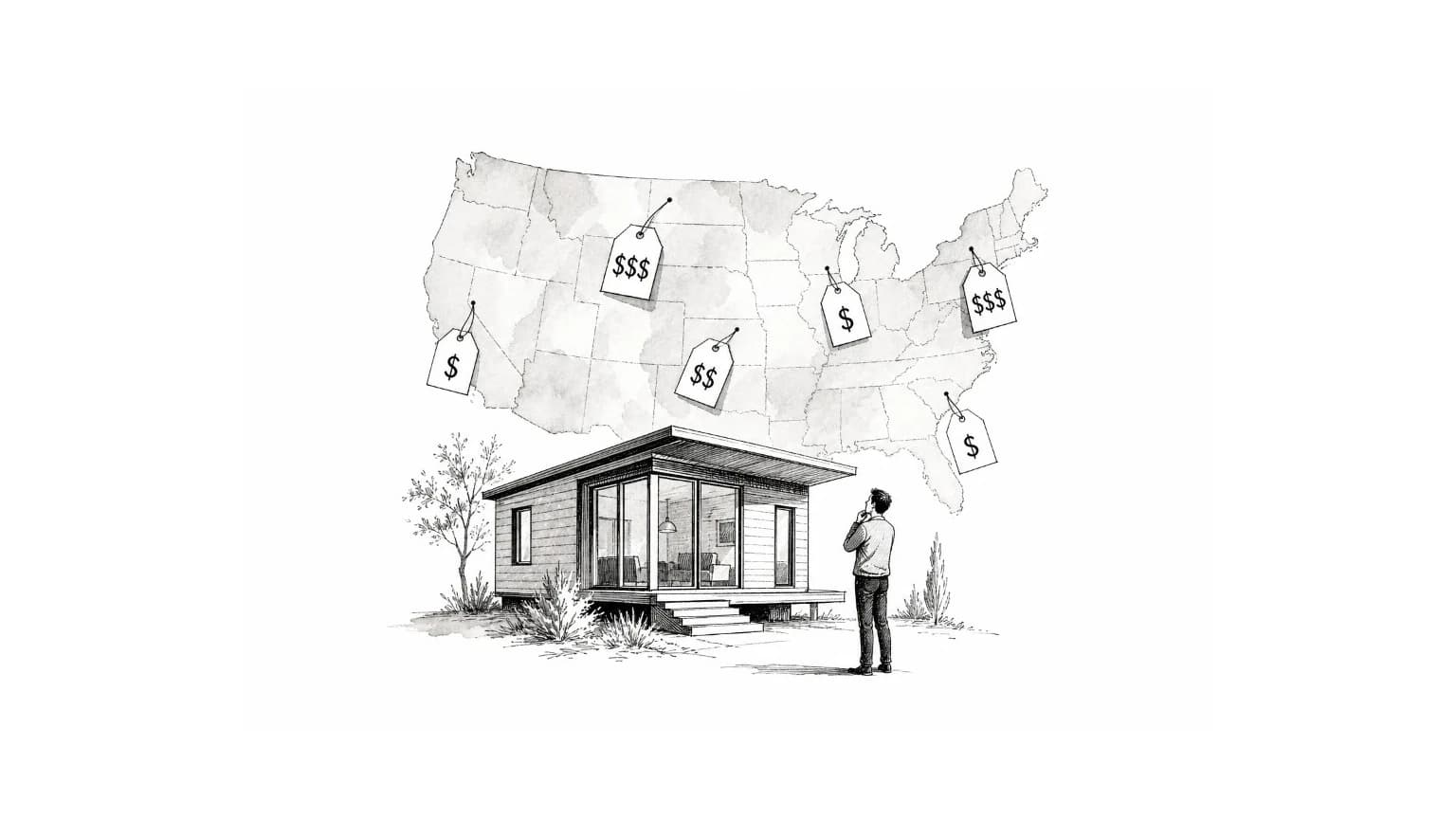
On the income side, long-term monthly rent for a one-bedroom ADU varies by metro. Studios usually lease below these bands. Two-bedrooms can clear them if zoning allows the size. Use these 2026 one-bedroom ranges as a planning baseline, then pull recent leased comps on your block:
| Metro | Long-term 1-bedroom ADU planning rent |
|---|---|
| Los Angeles | $2,000–$3,500 / month |
| San Francisco | $2,500–$4,000 / month |
| Seattle | $2,000–$3,400 / month |
| Austin | $1,600–$2,800 / month |
| Phoenix | $1,500–$2,500 / month |
A sample cash-flow model
Run this sample against your own rent and your own all-in bid. The rent is $2,400 a month, a mid-band one-bedroom in several of the metros above. Expenses are conservative on purpose.
| Line | Monthly |
|---|---|
| Gross rent | $2,400 |
| Vacancy (5%) | −$120 |
| Property management (8%) | −$192 |
| Property tax allocation | −$400 |
| Insurance | −$75 |
| Maintenance reserve (5%) | −$120 |
| Net operating income | $1,493 |
That is about $17,900 a year. Against a $185,000 all-in build, net yield is about 9.7% and simple payback is a little over 10 years. The same rent on a $250,000 coastal or complex-lot budget is about 7.2% and roughly 14 years. Drop the build to $150,000 on a flatter, utility-ready lot and payback shortens toward 8 or 9 years. None of those numbers is a flip. All of them are compounding value on land you already own, if the bid stays inside the scope you modeled.
Site work is where models break. On a simple suburban lot, grade, a straightforward foundation, and a short trench often run $15,000 to $45,000 as a bundle. A slope, poor soil, or a long sewer run can add another $20,000 to $50,000. What to expect beyond the factory sticker is the worksheet for those lines.
What the 2%, 50%, and 7% rules actually tell you
Investor forums will ask whether the project meets the 2% rule (monthly rent about 2% of cost), the 50% rule (half of rent reserved for operating costs, excluding the mortgage), or a 7% cash-yield target. They are filters, not ADU law.
A $185,000 backyard unit would need about $3,700 a month to pass a strict 2% test. Most new prefab ADU homes miss that bar because you are paying today's construction cost, not buying a discounted house. The sample above keeps about 38% of gross rent for operations before debt, so it is inside a 50% operating-cost screen. The 7% to 10% net yields in the examples are the more useful ADU ROI conversation: does this beat leaving the yard empty, after real vacancy and reserves?
Long-term rental vs short-term
Short-term platforms can post a higher gross month than a 12-month lease. Occupancy, cleaning, furnishing, and city rules take that premium back. Many California cities restrict or ban short-term rentals in ADUs. Other markets cap nights or require a separate license. For planning, use long-term rent as the baseline. Treat short-term as an upside case only after you read the ordinance.
A unit for rent on a 12-month lease is also the cleaner file if you later want a lender to count the income. Lease history and Schedule E are easier to document than a year of weekend occupancy.
Confirm zoning and permits before you order a unit
Many ADU projects stall at zoning. Before you pick a floor plan, confirm that the lot can legally hold a second dwelling. Your planning department's zoning map is the first stop. Most owners can answer the eligibility questions in about 20 minutes. Bring this packet when you go:
- Parcel map and zoning designation
- Lot size, setbacks, height, and lot-coverage limits
- Whether a primary residence with utilities already exists
- Parking rules and any short-term rental overlay
- Water, sewer, and electrical capacity, plus who owns the tap fees
California has the clearest statewide framework. State law requires most single-family lots to allow at least one detached ADU by right, and complete applications follow a ministerial path with a decision clock described in HCD's ADU handbook (60 calendar days once the packet is deemed complete). End-to-end, including corrections, utilities, and inspections, still commonly runs 3 to 6 months. Washington, Oregon, and Colorado have less uniform statewide preemption, so local timelines stretch. Texas and Arizona are jurisdiction-dependent: Austin plan review often sits in a 45 to 90 day band, while simpler Dallas or San Antonio files can move in 3 to 8 weeks.
Physical constraints matter as much as the clock. In California, state law caps rear and side setbacks for many detached ADUs at 4 feet, and height often sits around 16 feet. Utility hookups, tying into existing water and sewer or trenching new lines, are the cost surprise first-time ADU owners miss. A builder who has pulled an ADU permit in your city is worth more than another hour on the zoning PDF.
How to finance a backyard prefab ADU
A $150,000 to $300,000 project does not have to drain retirement accounts. The path depends on equity and whether you want a fixed payment or draws.
Home equity, construction loans, and programs that are actually open
A HELOC or a cash-out refinance is the usual route for equity-rich owners. Both can price closer to mortgage rates than a consumer loan. A HELOC fits a phased factory-plus-site draw. A cash-out refinance fits when you want one fixed payment folded into the existing mortgage and the new rate is acceptable.
If equity does not cover the build, a construction-to-permanent loan funds work in draws and converts to a longer mortgage at completion. Renovation products such as Fannie Mae HomeStyle or FHA 203(k) can underwrite against post-improvement value. The code path still matters: a local-code modular ADU on a permanent foundation is a different loan file than a HUD-code manufactured unit. Read How to get a mortgage for a factory-built home and modular home financing before you treat a catalog price as financeable. Prefably does not broker loans.
Public programs change faster than blog posts. CalHFA's ADU grant offered up to $40,000 for pre-development costs. The latest round was fully allocated on December 28, 2023. CalHFA is not accepting new applications. Anyone offering to get you that grant now is a red flag. In Massachusetts, MassHousing launched an ADU construction loan in March 2026: up to $250,000 for detached units and $150,000 for attached units, as a fixed-rate second mortgage for income-eligible owner-occupants who already have permits. Confirm live status with the city or county housing office before you put a grant on the spreadsheet.
Can you use ADU rental income to qualify?
This is the question most "how to generate income with an ADU" articles skip, and it is the one lenders actually ask.
Fannie Mae's Selling Guide now lets lenders count rental income from one existing ADU on a one-unit principal residence, for a purchase or limited cash-out refinance only. The qualifying amount from that ADU is limited to 30% of total qualifying income. Lenders typically apply a vacancy haircut (often 75% of gross rent) and still need a documented current housing payment. Borrowers with less than 12 months of property-management experience face tighter caps. The rules live in B3-3.1-08, Rental Income and B3-3.8-02, Rental Income from the Subject Property. Desktop Underwriter support for the ADU income path landed with DU 12.1 in 2026. Freddie Mac maintains a parallel ADU-income discussion on its single-family ADU page. Your lender's overlay can be stricter than either guide.
Existing is the word that matters. Projected rent on a backyard unit that is not built, not permitted, or not occupied usually does not qualify the construction loan. Once the ADU is legal, leased, and seasoned, that income is more likely to show up on a later refinance. Do not underwrite your own HELOC against a pro forma.
What to spec on a rental prefab ADU
A personal studio can chase a pretty catalog photo. A rental unit needs durability, a separate entrance, and low turnover cost. Prioritize exterior finishes that do not need repainting every few years, flooring that survives tenants, separate utility metering so the occupant pays their own bills, and a layout a stranger can live in without calling you about storage. Warranty length matters more when you are not on site to catch a leak.
Skip the national "best brand" list. Studio-fast, mid-market volumetric, and premium envelope products all exist. The useful split is still panelized vs modular vs manufactured, plus whether that company has set a unit in your county. A cheaper factory sticker on a HUD-code box can cost more in rate and resale than a local-code modular ADU that finances like the house in front.
- Ask what the structural, installation, and systems warranties cover, and for how long.
- Ask whether utilities are separately metered in the base price.
- Ask for a written turnkey scope: foundation, trench, crane, permits, and what is explicitly excluded.
- Ask for two local ADU permit references in your city or county, not a national gallery.
Timeline to the first rent check
Factory-only build time across common prefab ADU lines runs about 4 to 8 weeks. On-site set and connections add about 2 to 10 weeks. Permitting, if you start it after you sign a manufacturer contract, adds another 3 to 6 months in many cities. Jurisdictions with preapproved plan sets can compress review to 1 to 2 months. That best case is not national.
Total time from signed contract to rent-ready is commonly 6 to 12 months for a first ADU. Starting the permit packet before you lock a factory slot is the single largest time-saver. Every month of empty backyard after the crane leaves is lost rent on a project you already paid to entitle.
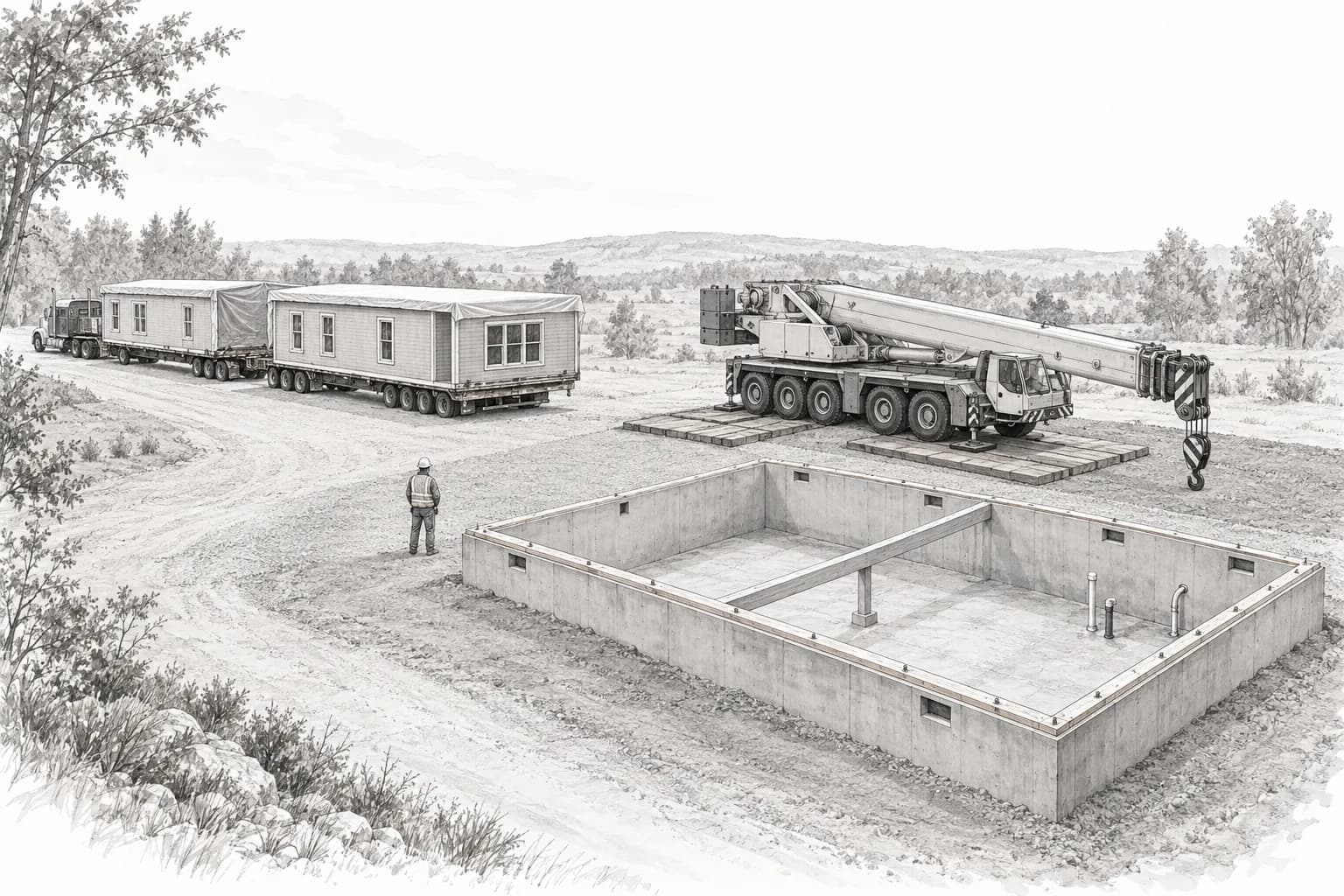
Set day is usually one calendar day once the foundation is ready and the crane can reach the pad. Overhead lines, a tight driveway, or a dense canopy can turn that day into extra cost. After the box is set, button-up (seams, siding, trim), utility tie-ins, and municipal inspections commonly add one to four weeks. Do not list the unit until you have a certificate of occupancy. A lease without a CO is how backyard projects become code-enforcement files.
From certificate of occupancy to a signed lease
Photograph the finished unit in daylight, including the separate entrance and any private outdoor space. List it as new construction with the legal bedroom count, not as a "guest house." Decide long-term vs short-term before you write the listing. If the city restricts Airbnb-style stays, do not advertise nights.
Screen for backyard living, not only credit. Shared driveways, trash, quiet hours, and guest parking need to be in the lease. Say who pays which utility. If the ADU is separately metered, say so. If it is not, a flat utility add-on beats an argument every month. A 12-month lease with those house rules is easier to show a lender later than a year of weekend occupancy.
Finding a local prefab ADU builder
Choosing a model on a website is half the decision. The company that delivers, sets, and finishes the unit on your lot decides whether the project hits the cash-flow model. A prefab ADU company that has never pulled a permit in your county will learn on your job.
Local ADU specialists know setback interpretations, utility sequences, and which soils trigger an upgraded foundation. That knowledge regularly cuts months and change orders. Finding those specialists without entering a lead marketplace is the usual wall. Prefably is built for that search: state hubs, builder-type chips including ADU, and direct contact. Unlike platforms that package buyer inquiries and sell them to several firms, Prefably does not sell leads or buyer contact information. Opening a profile does not start a phone-call rotation from companies you did not pick.
Filter by the state you will build in, then by ADU or modular type. Confirm the delivery radius and whether a crane can reach your pad. Search California, Texas, Washington, Arizona, or every state. Reach out to two or three companies that can show a local ADU permit. Ask what happens if plan check runs long. The answers tell you more than a review-site star average.
Next steps
A backyard prefab ADU can produce rent for decades when you build at a real all-in cost, price the unit against local leases, and reserve for vacancy and maintenance. Confirm zoning first. Start permitting before you freeze the manufacturer. Pick financing that matches your equity, and do not count projected rent as qualifying income until a lender says it does.
Use this guide to run the numbers, then use What is a prefab ADU to lock the product type. Shortlist ADU builders in your state on Prefably and contact them directly.
FAQ
- Does a prefab ADU for backyard rental income actually make financial sense?
- Often yes if you already own the lot, you can build at a realistic all-in cost, and local long-term rent covers vacancy, tax, insurance, management, and a maintenance reserve. A worked example at $2,400 rent and about $185,000 all-in lands near a 10% net yield. A $250,000 build on the same rent is closer to 7%. Run your city rents and your written installed bid, not a factory sticker.
- How much rental income can an ADU generate?
- Long-term one-bedroom ADU rents commonly plan around $2,000 to $3,500 in Los Angeles, $2,500 to $4,000 in San Francisco, $2,000 to $3,400 in Seattle, $1,600 to $2,800 in Austin, and $1,500 to $2,500 in Phoenix. Those are 2026 planning bands, not a lease. Short-term platforms can post higher gross months and lose that edge to occupancy rules and city bans.
- Can I use ADU rental income to qualify for a mortgage?
- Fannie Mae can count rent from one existing ADU on a one-unit principal residence for a purchase or limited cash-out refinance. Qualifying ADU income is capped at 30% of total qualifying income, and lenders typically haircut gross rent (often to 75%). Projected rent on a unit that is not built yet usually does not qualify the construction loan. Prefably does not broker loans. See Fannie Mae's rental income topic.
- How much does a prefab ADU cost all-in in 2026?
- Factory or kit quotes often run about $80 to $160 per square foot. Turnkey installed pricing, including foundation, utilities, delivery, set, and permits, more often lands around $250 to $525 per square foot nationally. Many 400 to 600 square foot rental units on simpler lots land near $150,000 to $280,000 all-in. Coastal California often sits higher. Compare installed prices. Details are in What is a prefab ADU.
- Is a prefab ADU cheaper and faster than stick-built for a rental?
- The factory box and the on-site window often are. The full project is not always. A prefab or modular ADU commonly lands in about 6 to 12 months from contract to rent-ready when permits cooperate. A comparable stick-built detached unit often takes 9 to 18 months. Long utility runs and slow plan check can erase the gap. Speed to first rent check is the rental-specific reason to compare factory-built.
- What is the 2% rule for an ADU rental?
- The 2% rule says monthly rent should be about 2% of project cost. A $185,000 ADU would need about $3,700 a month. Most backyard units miss that bar because you are building new construction, not buying a discounted house. The 50% rule (half of rent reserved for operating costs, excluding mortgage) is a better first filter. Land you already own is why a missed 2% test can still be a sound ADU investment.
- Do I need a permit to rent a backyard ADU?
- Yes. You need a legal accessory dwelling unit with a certificate of occupancy before you collect rent. Confirm zoning, setbacks, parking, and whether your city restricts short-term rentals. California has a statewide ministerial path for complete ADU applications. Texas, Arizona, and most other states leave more of that to the city or county.
- How do I find a prefab ADU builder near me?
- Confirm the lot can take a detached ADU, then shortlist companies that deliver to your state and have pulled ADU permits in your city or county. Prefably lists prefab and modular ADU builders by state. You contact them directly. We do not sell the inquiry as a lead. Start with California, Texas, or all states.
- Can prefab ADUs be customized?
- Yes, within the product type. Panelized kits allow more layout changes on site. Volumetric modular units lock more of the plan in the factory. Finishes, metering, and entrance details are the usual rental customizations. The type split and what you can change is in What is a prefab ADU.
Keep reading